
Kempton Park Course Guide: Track Analysis for King George Bettors
Why Course Knowledge Wins Bets
Kempton Park is not a generic National Hunt venue. Its peculiar characteristics—flat terrain, right-handed direction, triangular layout, excellent drainage—create conditions found nowhere else on the British racing calendar. Understanding this Kempton Park course guide provides betting edges invisible to punters who treat all tracks as interchangeable.
Know the track, know the value. This principle applies throughout National Hunt racing, but Kempton amplifies its importance. The King George VI Chase rewards specific attributes that only emerge when course demands are properly understood. Horses that struggle on undulating tracks might thrive at Kempton. Horses that excel on testing ground might underperform on Kempton’s well-drained surface. These variables create predictable mismatches between public perception and Boxing Day reality.
The course shapes outcomes in ways form figures alone cannot capture. A horse’s previous Kempton experience matters enormously. Its jumping technique matters in specific ways that differ from Cheltenham or Aintree requirements. Its stamina must be of a particular type—relentless galloping rather than hill-climbing endurance. Each of these factors can be analysed, and each creates betting implications.
What follows examines Kempton’s characteristics systematically: track layout, fence positions, the decisive run-in, going conditions, horse types that excel, and the external factors—weather, attendance, uncertain future—that affect Boxing Day betting. This technical knowledge, properly applied, transforms King George analysis from guesswork into informed assessment.
Track Layout and Dimensions
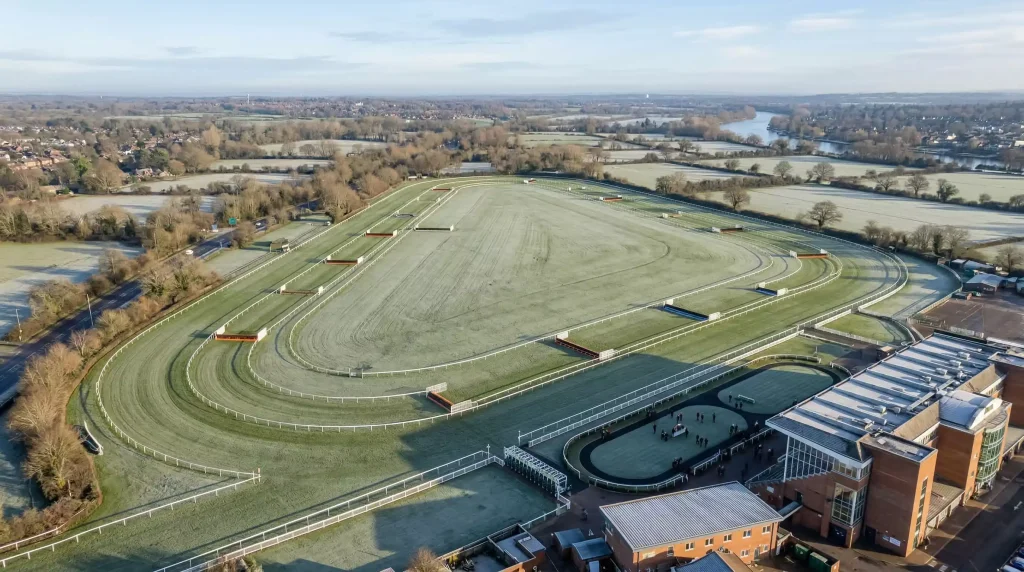
Kempton’s chase course measures approximately one mile and five furlongs in circumference, with the King George covering almost exactly two circuits. This triangular layout differs fundamentally from the oval configurations at most British courses, creating distinct navigational demands.
The right-handed direction matters more than casual observers appreciate. Horses naturally favour one direction over the other, just as humans are right-handed or left-handed. A horse uncomfortable turning right must fight its instincts throughout eighteen fences and three miles, a cumulative disadvantage that compounds as the race progresses and fatigue sets in.
Perhaps Kempton’s most distinctive feature is its flatness. The course rises and falls negligibly compared to tracks like Cheltenham, where the famous hill dominates final furlongs, or Haydock, where undulations test stamina differently than pure distance. Kempton’s level circuit rewards horses that maintain consistent pace without the recovery opportunities that hills provide. Frontrunners face no significant gradients to slow pursuers; closers find no downhill assistance to launch late attacks.
This flatness favours particular running styles. Horses that power up hills might find Kempton’s galloping demands differently challenging. Horses that excel on flat tracks, particularly gallopers rather than grinders, often perform above expectation at Kempton regardless of their results elsewhere. This style preference creates betting angles when form on undulating tracks misleads assessment of Kempton suitability.
The triangular shape introduces tighter turns than oval courses. The bends at Kempton require horses to maintain balance while changing direction, then resume forward momentum without losing position. Horses that race efficiently through corners gain ground on those who lose rhythm when turning. This element rewards jockey skill alongside horse ability.
The three-mile King George trip sees runners complete almost exactly two full circuits, beginning and finishing near the same point after navigating each section of the triangle twice. Understanding where horses are positioned relative to their competitors at each stage of each lap helps interpret how races develop.
Fence Positions and Jumping Demands
The King George features eighteen fences across three miles—nine per circuit. Their positions around the triangular course create specific jumping challenges that reward certain abilities while exposing weaknesses in others.
Kempton’s fences are well-maintained and relatively inviting by National Hunt standards. They do not present the technical challenges of Aintree’s Grand National fences or the stamina-sapping demands of Cheltenham’s undulating obstacles. Competent jumpers clear them without drama; poor jumpers accumulate small errors that cost ground incrementally.
The positioning of fences relative to bends demands attention. Fences approaching turns require horses to clear obstacles while preparing to change direction. Fences on straight sections allow more straightforward approaches. Horses comfortable taking fences at varied angles, without needing perfect setup every time, handle Kempton better than those requiring methodical preparation.
Fall rates at Kempton run below the National Hunt average. The flat terrain, well-presented fences, and generally good ground reduce accident likelihood compared to more demanding tracks. This relative safety increases the probability that quality horses complete the course, reducing the randomness that causes upsets elsewhere. The best horse more often proves the best horse at Kempton because fewer external factors intervene.
For bettors, this reliability has mixed implications. Favourites face fewer non-completion risks, making short prices more defensible than at tracks where carnage regularly eliminates market leaders. But the reduced randomness also means that identifying value becomes harder—the market’s assessment of likely winners faces fewer disruptions from chance events.
The second circuit tends to produce more errors than the first. Tired horses jump less cleanly, and accumulated fatigue shows at fences that seemed straightforward earlier. The fences between turns, where horses face obstacles after navigating bends, see particular deterioration in jumping quality as the race progresses.
The Crucial Run-In
Kempton’s run-in measures approximately 175 yards from the final fence to the winning post. This relatively short distance creates racing dynamics significantly different from tracks with longer run-ins.
A 175-yard run-in means that the last fence effectively decides most King Georges. Horses that jump it cleanly, landing running, hold decisive advantage. Those that make errors—pecking on landing, losing momentum, requiring jockey assistance—face limited opportunity to recover. The gap created at the last fence often proves the winning margin.
This configuration rewards horses that jump fluently under pressure. The final fence arrives after eighteen obstacles, three miles, and accumulating fatigue. Tired horses jump worse. The ability to maintain jumping technique when exhausted separates winners from losers. Bettors should examine how prospective runners have jumped late in races, particularly how they handle the final fence of three-mile chases.
The short run-in minimises the advantage of late bursts of speed. A horse with devastating finishing pace—capable of running down rivals in the final 300 yards—finds less opportunity to deploy that weapon at Kempton. The race is effectively over by the final fence. Conversely, horses that jump and gallop rather than finish with acceleration can build unassailable leads that shorter closers cannot bridge.
Jockeys familiar with Kempton understand this dynamic. They position horses to jump the last fence competitively rather than waiting for a run-in charge that cannot materialise. Riders new to Kempton sometimes make tactical errors, sitting too far back and finding insufficient distance to close gaps their horses might bridge on longer run-in tracks.
For betting purposes, the short run-in increases the importance of jumping ability relative to raw speed. Horses that jump well but lack acceleration find Kempton advantageous. Horses with brilliant finishing kicks but inconsistent jumping face disadvantages the track emphasises.
Going Conditions at Kempton
Kempton’s drainage system ranks among the best in British racing. The course rarely becomes waterlogged, rarely produces genuine heavy ground, and typically offers conditions faster than December weather might suggest. This tendency toward quicker going shapes expectations for the King George regardless of surrounding rainfall.
The well-drained surface means that soft ground at Kempton differs from soft ground elsewhere. What the going stick measures as soft at Kempton often rides faster than comparable readings at less efficient venues. Horses that prefer genuinely testing conditions might find Kempton softer than expected—soft on the official going but quick enough underfoot to disadvantage their running style.
Typical Boxing Day conditions range from good to soft through to soft. Genuine heavy ground remains rare; good ground, while possible in dry Decembers, occurs less frequently than middle-ground conditions. Punters should assume soft-side going unless forecasts suggest unusually dry weather in the final week before Christmas.
Ground preferences matter enormously for King George betting. Horses whose form excels on heavy ground might underperform on Kempton’s quicker-than-expected surface. Horses needing faster going might find Kempton suitable even when official descriptions suggest otherwise. Cross-referencing going preferences with Kempton’s drainage characteristics reveals mismatches invisible to those accepting official going at face value.
The track’s drainage also reduces race-day variability. Unlike courses where morning rain transforms conditions, Kempton’s surface remains relatively consistent throughout a fixture. The King George, run in the afternoon, faces fewer surprises from weather events earlier in the day. This predictability helps bettors who have analysed conditions in advance.
Ground staff at Kempton manage the surface actively before major fixtures. Watering in dry conditions, drainage in wet, and careful attention to vulnerable areas help maintain racing-quality ground. Their expertise ensures Boxing Day racing proceeds on safe, competitive surfaces regardless of December’s unpredictable weather.
Horse Types That Excel
Kempton rewards gallopers—horses that build speed steadily and maintain it relentlessly—rather than those dependent on tactical variation or uphill strength. Understanding this preference helps identify runners whose profiles suit Boxing Day regardless of form at other venues.
The flat, right-handed track favours horses that cruise efficiently at sustained pace. Gallopers develop rhythm early and maintain it throughout, losing minimal energy to acceleration and deceleration. At Kempton, where no hills interrupt this rhythm, such horses perform at their best while competitors face unfamiliar demands.
The statistics support this profile. According to The Stats Don’t Lie, 6 of the last 12 King George winners had a previous victory at Kempton. This correlation between prior course success and King George victory reflects horses whose style matches Kempton’s particular requirements. They won before because the track suits them; they win again for the same reason.
Horses that excel on undulating tracks face questions at Kempton. Their strength—powering up hills while rivals struggle—becomes irrelevant on flat ground. Their racing tactics, developed for terrain that does not exist at Kempton, may prove ineffective. This does not mean such horses cannot win—form overrides track preference sometimes—but it introduces uncertainty that market prices may not adequately reflect.
Jumping efficiency matters, as discussed elsewhere, but jumping style also influences outcomes. Horses that jump extravagantly—gaining air, clearing fences with heights to spare—expend energy that economical jumpers conserve. Over eighteen fences, these efficiency differences accumulate. The neat, economical jumper arrives at the final fence with more energy than the flashy but wasteful leaper.
Runners from Ireland face particular scrutiny. Irish training centres feature different terrain than Kempton. Horses conditioned on hilly gallops might struggle with Kempton’s flat demands. Conversely, horses from flat Irish yards might find Kempton’s configuration familiar. Analysing where horses train, not just where they race, provides additional insight.
Draw and Position Bias
Unlike flat racing, where draw advantages can prove decisive, National Hunt racing generally minimises such biases. The King George, with its lengthy trip and numerous fences, dilutes any initial positional advantage through distance and tactical development.
Starting positions at Kempton matter less than at flat tracks because runners have three miles to establish preferred positions. The initial strides affect little when the race continues for several minutes. Jockeys settle horses according to racing style rather than draw, and the wide field disperses around the first bend.
Tactical positioning does matter, but it emerges from racing decisions rather than starting arrangements. Frontrunners must establish early presence; holders-up need to avoid traffic. These considerations depend on horse preferences and jockey skill rather than arbitrary draw assignments.
The triangular layout does create positional dynamics. Horses racing wide through bends cover extra ground. Over two circuits, the cumulative distance adds up. Good jockeys save ground through turns, positioning horses on the inner when possible without compromising opportunity to challenge.
The home turn before the final stretch deserves particular attention. Horses positioned toward the outer through this turn face longer distances to the last fence. Those racing on the rail save ground but risk becoming blocked. The balance between ground saved and room to manoeuvre separates skilful jockey performances from tactical errors.
For betting purposes, draw biases do not warrant significant weighting. Jockey track records at Kempton—their ability to navigate bends efficiently and position horses optimally—matter more than where horses start. Analysing jockey statistics at the venue provides more useful information than draw data.
Weather Impact on Boxing Day
December weather in Surrey remains unpredictable. The King George has been run in conditions ranging from unexpectedly mild to bitterly cold, from waterlogged afternoons to surprisingly dry days. Weather monitoring in the final week before Christmas becomes essential for serious punters.
Frost presents the primary abandonment risk. Kempton’s excellent drainage handles rain effectively, but frozen ground creates safety concerns that no drainage can address. Racing authorities inspect courses on Boxing Day morning if overnight temperatures drop below freezing, occasionally postponing or abandoning meetings that prove unsafe.
The risk of abandonment affects ante-post betting calculations. Standard ante-post rules mean losing stakes if the meeting does not proceed. Non-Runner No Bet offers typically cover individual horses withdrawing but not meeting abandonment. Understanding this distinction matters when committing significant stakes weeks before Boxing Day.
Rainfall in the days before Christmas shifts ground conditions and therefore which horses gain advantage. Sustained rain produces softer going that favours mudlarks and stamina merchants. Dry spells allow the surface to remain quicker, suiting speedier types. Checking forecasts daily from 20 December onward helps anticipate likely conditions.
Wind rarely affects outcomes directly—Kempton’s flat layout offers no particular wind exposure—but temperature does influence horse performance. Very cold conditions tend to produce sharper, quicker performances. Mild weather can produce flat, uninspiring racing. These subtle effects rarely override form considerations but contribute to race dynamics.
Late scratches due to weather-related concerns occasionally reshape fields. Trainers may withdraw horses whose ground preferences conflict with Boxing Day conditions, particularly if alternative targets exist at different venues. Such withdrawals can concentrate fields on horses suited to conditions, potentially shortening prices on remaining runners.
For bettors, weather monitoring informs late-stage decisions. Conditions clarify as Boxing Day approaches, allowing reassessment of earlier analysis. A horse backed ante-post based on expected soft ground might warrant laying if conditions trend quicker. Conversely, a horse dismissed as ground-dependent might merit reconsideration if weather delivers suitable conditions.
Attendance and Atmosphere
Boxing Day attendance at Kempton reflects both the race’s prestige and broader trends affecting British racing. According to Racing Post reporting, the 2026 meeting attracted 17,195 racegoers, an increase of 3,332 compared to 2026. This uptick suggests renewed interest, though context reveals a more complex picture.
Longer-term attendance data tells a different story. According to OLBG’s attendance analysis, Kempton’s annual attendance dropped from 144,193 in 2014 to 74,926 in 2023—a decline exceeding 48% over a decade. Boxing Day remains the venue’s flagship fixture, but the surrounding programme has contracted alongside falling general interest.
The Boxing Day atmosphere differs from routine fixtures. Christmas crowds arrive in festive mood, many attending racing for the only time each year. This creates an occasion distinct from regular meetings—more celebratory, less analytically focused, but genuinely special in its own character.
Crowd dynamics can influence horses unfamiliar with big-race atmospheres. The noise, the packed enclosures, the general intensity of a Boxing Day meeting might unsettle horses accustomed to quieter fixtures. Experienced King George runners have demonstrated ability to handle the occasion; first-time visitors face an unknown test.
For punters attending in person, the atmosphere enhances the spectacle without necessarily improving betting decisions. The excitement of a live Boxing Day crowd can encourage impulsive wagering, backing horses based on appearance or paddock presence rather than systematic analysis. Those betting on course should make selections before arriving, resisting the temptation to abandon planned approaches amid festive enthusiasm.
Television coverage amplifies the occasion beyond those physically present. ITV Racing typically dedicates extensive Boxing Day programming to Kempton, with the King George forming the centrepiece. This broadcast exposure maintains the race’s profile despite attendance fluctuations, ensuring it remains among Britain’s most-watched annual sporting events.
Kempton’s Future: The Redrow Question
Kempton Park’s long-term future remains uncertain, creating an unusual backdrop for Britain’s premier Boxing Day fixture. The Jockey Club’s 2017 announcement of a potential sale to housing developer Redrow generated controversy that continues reverberating through the sport.
The original proposal would have seen Kempton close, its land developed for residential housing, with racing relocated to a new all-weather venue. Public outcry, industry opposition, and practical complications delayed these plans. A 2020 revision confirmed racing would continue at Kempton “for the foreseeable future,” but the underlying uncertainties persist.
For bettors, this uncertainty introduces unusual considerations. The King George might eventually relocate to another venue, fundamentally changing the race’s character. Kempton-specific analysis would become obsolete overnight. Horses with proven Kempton form would lose their track advantage. The entire statistical foundation supporting trend analysis would require reconstruction.
Willie Mullins, the champion Irish trainer, captured the industry’s ambivalence when discussing the venue after the 2026 King George. Speaking to Racing Post, he said: “It’s a great race for Kempton, and hopefully it won’t be the last King George here.” That qualified optimism reflects widespread sentiment—appreciation for what Kempton provides combined with anxiety about its permanence.
The practical betting implication: Kempton-specific trends retain full relevance for the 2026 renewal and likely for several subsequent years. Any relocation would involve substantial lead time, allowing punters to adjust approaches. Current analysis assuming Kempton’s continuation remains valid while monitoring announcements that might signal change.
Should relocation eventually occur, the King George would need to find a new home that approximates Kempton’s distinctive characteristics. A flat, right-handed track with comparable galloping demands would preserve some continuity. A relocation to an undulating, left-handed course would fundamentally redefine which horses prosper. The choice of any alternative venue would reshape King George betting for generations.
For now, Kempton hosts the King George, and its particular demands drive betting analysis. The uncertainty about tomorrow does not diminish the relevance of understanding today’s track. Whatever the future holds, the 2026 King George will be run at Kempton Park, on Boxing Day, over three miles and eighteen fences—the same race it has been for decades, regardless of what comes after.