
King George VI Chase History and Origins
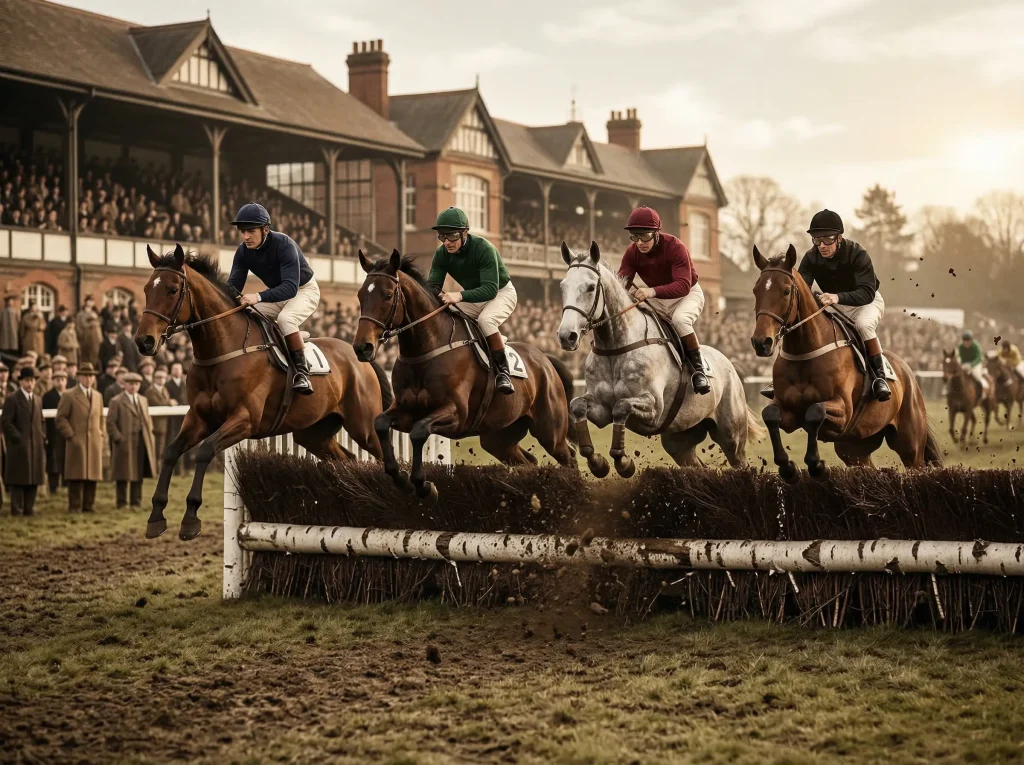
A Race Born of Royalty
The King George VI Chase carries royal lineage in its name. Established in honour of Britain’s wartime monarch, the race embeds national identity into National Hunt racing. A race fit for a king—the title proved prophetic across nearly nine decades of Boxing Day drama.
Naming races after royalty was common in British racing’s golden era. The gesture acknowledged patronage, celebrated national identity, and elevated events beyond mere sporting contests. King George VI’s association with racing made him a natural choice; his accession in 1936 followed by the race’s creation in 1937 wasn’t coincidental.
The royal connection persists symbolically rather than actively. Today’s Royal Family maintains racing interests primarily on the flat, and the King George runs without regular royal attendance. Yet the name remains—a historical anchor connecting modern Boxing Days to mid-century Britain and the tradition established when steeplechasing was rougher, smaller, and more genuinely amateur.
1937: The Inaugural Running
The first King George VI Chase ran on Boxing Day 1937 at Kempton Park. Southern Hero won the inaugural edition, establishing a template that would endure: quality staying chasers contesting Kempton’s triangular circuit in the Christmas holiday window.
The race conditions differed from modern parameters. Distance, weights, and qualification criteria evolved over subsequent decades. The 1937 running represented an experiment—creating a major steeplechase to fill the Boxing Day calendar and provide top-class racing during the festive period.
Kempton’s selection as the venue reflected the track’s position in London’s racing orbit. Unlike distant Cheltenham or rural Aintree, Kempton offered metropolitan accessibility during a holiday period when travel limitations mattered. The flat, well-drained track promised raceable conditions in December weather that more exposed courses couldn’t guarantee.
Prize money in 1937 bore no relation to modern purses—a few hundred pounds rather than hundreds of thousands. Yet the prestige attracted serious contenders from leading stables. Winning the King George established bragging rights that transcended monetary value; the race mattered immediately.
The immediate pre-war years saw the race establish itself before interruption. Winners came from top yards; crowds attended in numbers suggesting genuine public interest. The King George entered racing’s fixture list as a significant event rather than a minor addition, justifying the royal naming within its first seasons.
Historical records from 1937-1939 reveal smaller fields and different competitive dynamics than modern renewals. Fewer horses trained for jumping at elite level; fewer trainers targeted specific races with sophisticated preparation. The King George’s early editions reflected an era when steeplechasing remained more informal than the professional sport it would become.
Wartime and Return
World War II suspended the King George from 1940 through 1946. Racing continued in limited form during the war years, but major events at major tracks became impractical. Kempton itself served various wartime functions; the track’s facilities contributed to national effort rather than national entertainment.
The absence highlighted what peacetime racing would lose without such fixtures. Horses continued training where possible; some raced in restricted programmes. But the grand spectacle of Boxing Day at Kempton—crowds, competition, celebration—disappeared for seven years.
The race returned in 1947, renamed and restructured but spiritually continuous with pre-war editions. Post-war Britain craved normalcy; restored fixtures like the King George provided exactly that. The 1947 renewal drew crowds eager to resume traditions interrupted by conflict.
The post-war period saw the race mature into its modern form. Grade designations, improved prize money, and enhanced television coverage came gradually. The King George evolved from a significant race among many into the defining Boxing Day event in British National Hunt racing.
By the 1950s, the race occupied its current status—unmissable for serious staying chasers, anticipated by racing audiences, and integral to the winter jumping calendar. The wartime gap became historical footnote rather than disruption; continuity was re-established comprehensively.
Evolution of the Race
The King George has undergone technical evolution while maintaining essential character. Distance settled at three miles—the same trip as the Cheltenham Gold Cup, establishing the race as a genuine championship test rather than a specialist sprint or marathon.
Grade 1 status, formalised in the modern grading system, confirmed the race’s position atop National Hunt’s hierarchy. The designation means weight-for-age conditions, attracting the best rather than handicapping them into equality. Only top-rated horses compete credibly; lesser runners are exposed rather than protected.
Prize money growth tracked betting industry expansion. What began as modest sums grew through the 1980s and 1990s as Levy funding increased and racing’s commercial position strengthened. The King George became financially attractive alongside being prestigious—a combination that ensures continued targeting by serious connections.
As BHA Chief Executive Brant Dunshea acknowledged regarding British racing more broadly: “It is no secret that the sport has experienced a challenging period as it faces up to the process of change at a governance level, but I want to be clear that this has not stopped the BHA and the industry making important progress to safeguard the long-term health of British racing.” The King George’s stability through industry challenges reflects its embedded importance.
Kempton’s status as the race’s home has faced periodic threat. Development proposals for the site generated controversy in the late 2010s; racing interests defended the venue successfully. The King George remains at Kempton because moving it would diminish both race and racecourse—the association strengthens both parties.
Modern iterations feature television coverage, international entries, and commercial structures unimaginable in 1937. Yet the core proposition—top staying chasers contesting Kempton on Boxing Day—remains unchanged. Evolution has enhanced rather than transformed.
Iconic Moments
Arkle’s victories in 1965 added the King George to his extraordinary collection. The greatest steeplechaser in history didn’t race Kempton frequently, but when he did, dominance followed. His presence elevated the fixture; his victories certified that the King George attracted racing’s ultimate talents.
Desert Orchid’s four wins between 1986 and 1990 created the race’s most sustained emotional narrative. The grey horse became synonymous with Boxing Day at Kempton; his era established the King George as culturally significant beyond racing circles.
Kauto Star’s five wins between 2006 and 2011 established the modern record. His 2011 comeback, reclaiming the title from Long Run at age eleven, ranks among the sport’s most celebrated moments. The combination of athletic achievement and emotional resonance created a race that transcended normal sport.
Long Run’s back-to-back victories in 2010 and 2011 demonstrated that champions can emerge from unexpected angles. Trained by Nicky Henderson rather than dominant Paul Nicholls, Long Run ended one era and briefly established another before Kauto Star’s revenge mission succeeded.
Less celebrated moments populate the race’s history—narrow finishes, controversial stewards’ inquiries, dramatic fallers who might have won. Each renewal adds to accumulated narrative; each Boxing Day extends history that began in 1937 and continues toward futures not yet imagined.
The Boxing Day Tradition
December 26 matters specifically. Boxing Day in Britain carries its own character—neither Christmas Day’s intensity nor ordinary life’s routine. Racing fills the gap perfectly, providing entertainment that excuses escape from family obligations and occupies the peculiar limbo between festivities.
The tradition anchors racing’s presence in public consciousness. People who ignore racing year-round know the King George happens on Boxing Day. The fixture commands attention beyond racing media, appearing in mainstream sports coverage and holiday planning conversations.
An industry employing 85,000 people depends partly on events like the King George maintaining public profile. According to House of Commons research, racing’s economic contribution extends from prize money through employment, breeding, tourism, and betting revenue. The King George concentrates attention at a moment when competing attractions—football, family, sales shopping—might otherwise dominate.
The tradition’s resilience suggests genuine cultural resonance. Television schedules might change; betting technology transforms; competing entertainments multiply—yet Boxing Day racing persists. The King George survives because it offers something audiences value: drama, tradition, and spectacle wrapped in familiar festive packaging.
Future generations will inherit the tradition or let it fade. Current attendance and viewing figures suggest inheritance remains likely. The King George VI Chase approaches its centenary having outlasted the monarch it honours, having survived war and industry turmoil, having entertained millions across nearly nine decades. The next ninety years begin with each Boxing Day renewal.