
King George Accumulator Strategies
 Available in US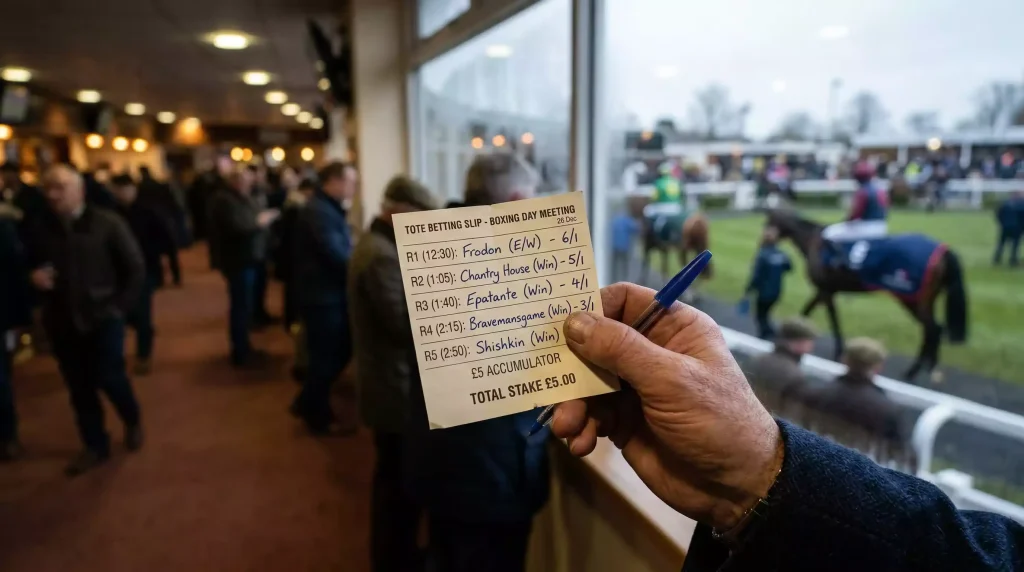
The Accumulator Appeal
Accumulators transform small stakes into dream payouts. The mathematical reality—multiplying odds across multiple selections—creates potential returns that single bets can’t approach. A £10 accumulator landing across Boxing Day’s card might return hundreds or thousands; the same £10 on single bets returns far less even if all selections win.
The dream ticket appeals for good reasons. Boxing Day provides multiple betting opportunities across a single afternoon; combining selections creates engagement with the full card rather than isolated interest in individual races. The accumulator turns Boxing Day into a progressive narrative where each winner builds toward the climax.
The reality demands acknowledgment alongside the appeal. Accumulators are hard to win. Each additional leg reduces probability multiplicatively; a four-fold at even money has roughly 6% win probability. The bookmaker margin compounds across legs, meaning expected value deteriorates as selections increase. The big payout exists precisely because it’s unlikely.
King George Accumulator Strategies — More on this topic at king george betting.
Types of Multiples
Doubles combine two selections; both must win for the bet to pay. The simplest multiple, doubles offer modest return enhancement over singles while maintaining reasonable win probability. A double including the King George and one supporting race represents manageable ambition.
Trebles extend to three selections—all must win. The probability reduction from double to treble is significant; the return enhancement is correspondingly larger. Trebles across Boxing Day might include the King George alongside morning and afternoon selections from the supporting card.
Four-folds and beyond multiply risk and return further. Each additional leg halves approximate win probability while doubling potential returns. The balance between ambition and realism shifts unfavourably beyond four or five selections for most punters.
Lucky 15 bets cover fifteen separate wagers across four selections: four singles, six doubles, four trebles, and one four-fold. The structure ensures returns from any single winner while maintaining accumulator upside. The total stake is fifteen times the unit stake—a £1 Lucky 15 costs £15.
Lucky 31 extends the concept to five selections: 31 bets covering all combinations. Lucky 63 covers six selections with 63 bets. These larger full-cover bets suit punters wanting guaranteed returns from any single winner across multiple races while maintaining the possibility of substantial payouts if all selections win.
Yankees cover eleven bets across four selections: six doubles, four trebles, and one four-fold. No singles are included; at least two selections must win for any return. The structure requires more success than Lucky 15 but costs less for equivalent unit stakes.
Patent bets cover seven wagers across three selections: three singles, three doubles, and one treble. The structure suits confident treble seekers who want protection if one leg fails. A single winner returns stake; two winners profit; three winners produce treble returns plus bonus accumulation.
According to BHA data, average field sizes for jump racing run at 7.84 runners. This context matters for accumulator construction—smaller fields mean fewer runners to beat, improving individual leg probability.
Building a Boxing Day Acca
Selection strategy for accumulators differs from single-bet analysis. Each leg should represent genuine confidence rather than speculative hope; weak links break chains regardless of other legs’ strength. Including a “maybe” selection because it’s a big price undermines the entire accumulator.
Mixing favourite and outsider selections balances probability and price. An accumulator of four short-priced favourites might have reasonable win probability but return little more than a single outsider bet. Including one or two selections at longer odds—horses you genuinely fancy at the price—creates meaningful return potential.
Kempton’s Boxing Day card typically includes the King George plus supporting Grade 1 and Grade 2 races. These high-quality contests attract competitive fields where form analysis applies reliably. Building accumulators from Kempton’s feature races—rather than handicaps where randomness increases—improves analytical foundation.
Avoiding races where you lack strong views improves accumulator construction. Forcing a selection in every Boxing Day race—because you want multiple legs—leads to including horses you don’t genuinely support. Better to build a treble from three confident selections than a five-fold including two lukewarm picks.
Timing selections requires attention to sequential running order. If early legs lose, later legs become irrelevant emotionally even if still theoretically active. Consider whether you want the King George as climactic final leg or secure early leg—both approaches have psychological merit.
King George as Anchor
Using the King George as accumulator anchor means building other legs around your King George selection. The anchor approach treats the King George as banker—the selection you’re most confident in—while other legs add return enhancement.
The King George’s status as the day’s feature makes it natural anchor material. Most Boxing Day bettors have King George opinions; building outward from that opinion toward supporting races creates logical accumulator structure.
Anchor strength matters enormously. If your King George selection loses, the accumulator loses regardless of other legs. The anchor must represent genuine confidence—not hope, not gambling, but analytical conviction that this horse offers edge at the price.
Alternative approaches build accumulators around supporting races with the King George as added leg. If you lack strong King George conviction, treating it as enhancement rather than foundation might suit better. The approach acknowledges uncertainty while maintaining accumulator engagement.
Mixing Kempton selections with other Boxing Day venues expands options but complicates analysis. Other tracks race on Boxing Day; including selections from Wetherby or Wincanton alongside Kempton creates broader coverage but requires researching multiple venues. The effort scales with ambition.
Risk Management
Each-way accumulators provide insurance against near-misses. When selections place without winning, each-way stakes return portion of original outlay. The protection costs money—each-way accumulators require double stake for the place portion—but prevents total loss when one selection finishes second.
Partial accumulator approaches split intended stake across multiple smaller accumulators. Rather than one £10 four-fold, placing five £2 four-folds with overlapping selections spreads risk. Some combinations will fail regardless; others might land while the original single accumulator wouldn’t.
Cash-out during accumulator progression creates decision points. If three of four legs have won, booking partial profit through cash-out versus letting the final leg run represents classic risk-reward trade-off. No universally correct answer exists—personal risk tolerance determines optimal choice.
Setting accumulator stakes appropriately acknowledges their speculative nature. Stakes appropriate for single bets are typically too high for accumulators; the lower probability requires proportionally smaller commitment. Treating accumulator stakes as entertainment cost rather than investment helps maintain perspective.
When Accas Make Sense
Accumulators make sense for entertainment purposes with realistic expectations. Turning £5 into potential £500 creates excitement that £5 single bets don’t match. The entertainment value justifies stakes you’re comfortable losing, knowing probability favours the bookmaker.
Small-stake, high-upside approaches suit accumulator structure. Punters who’d stake £50 on singles might better allocate £10 to accumulators, preserving bankroll while maintaining dream-ticket possibility. The expected value deteriorates, but the expected entertainment increases.
Social betting contexts favour accumulators. Sharing an accumulator with friends or family—everyone contributing to stake, everyone invested in each leg—creates collective excitement that individual betting lacks. Boxing Day gatherings provide natural accumulator-sharing opportunities.
Accumulators don’t suit serious profit-seeking. The margin compounding across legs makes consistent accumulator profit essentially impossible. Professional bettors rarely use accumulators precisely because the mathematics don’t support profitability. The structure suits entertainment rather than investment.
Boxing Day specifically suits accumulator engagement. The full card provides natural multi-race involvement; the festive atmosphere matches accumulator excitement; the stakes feel appropriate to celebration rather than serious wagering. The dream ticket matches the dream day—unlikely to land, delightful if it does.
See also Dutching King George Selections.
