Best Odds Guaranteed for King George
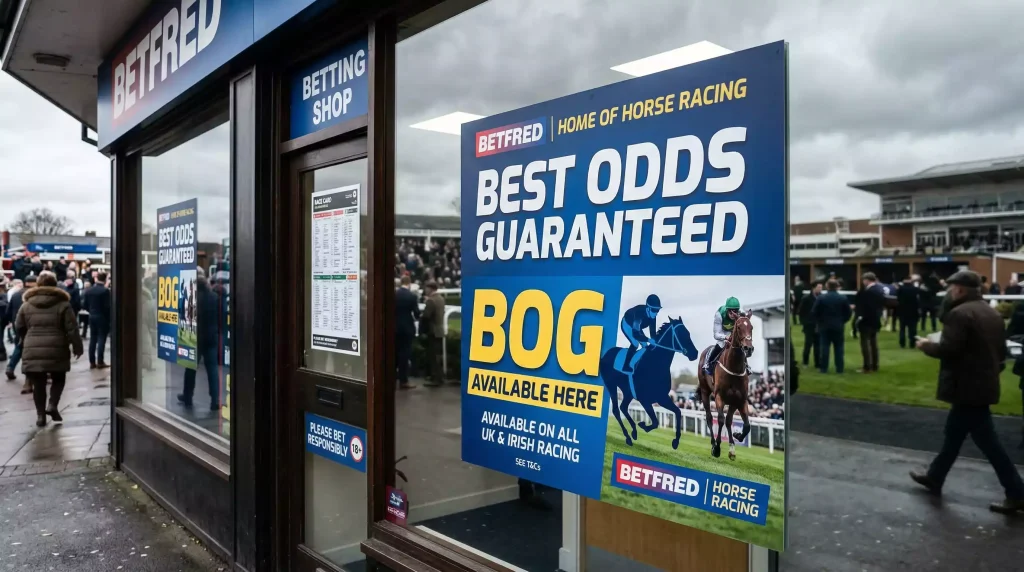
What Is BOG
Best Odds Guaranteed—BOG—ensures you never miss out on a bigger starting price. Take a morning price on your King George selection; if the SP drifts higher, your bet automatically pays at the better rate. The principle is straightforward: price protection without sacrificing early-market value.
BOG has become standard across major UK bookmakers for domestic racing, though terms vary considerably between operators and sometimes between race types. Understanding exactly what your bookmaker offers—and what they exclude—determines whether BOG meaningfully affects your betting approach.
The feature particularly benefits punters who identify value early in the day. Without BOG, backing at 8/1 when the SP ultimately returns 12/1 would cost you four points of potential profit. BOG closes that gap, rewarding early-market participation without punishing accurate price assessments. Never miss out on a bigger SP—that’s the promise. The reality involves a few more considerations.
How BOG Works
The mechanics are simple in principle. You place a bet at the available price—say, 6/1 on a King George contender in the morning. The market moves throughout the day. When the race goes off, the starting price is returned at 8/1. Under BOG terms, your bet pays at 8/1, the higher of your taken price and the SP.
If the SP is lower than your price, you keep your original odds. Backing at 6/1 when the horse starts at 4/1 returns 6/1. BOG only upgrades; it never downgrades. This one-way protection makes early betting risk-free from a price perspective—you capture any drift without exposure to market shortening.
The industry context matters. British racing relies heavily on betting revenue; the Plumpton Report noted that Britain returns just 0.6% of betting turnover to prize money—the lowest rate internationally. Bookmakers compete aggressively for racing bettors, and BOG represents one of their principal retention tools. It costs them margin on drifters but keeps punters within their ecosystem rather than price-shopping between operators.
Settlement is automatic. You don’t need to claim the difference or contact customer support. The slip simply pays at whichever odds favour you. Most bookmakers display both your taken price and the SP on settled bets, showing when BOG has applied.
Be aware that BOG applies to win odds only—not to place odds in each-way bets. If you back each-way at 12/1 and the SP is 16/1, your win bet pays at 16/1, but your place bet still pays at one-quarter of your original 12/1 (i.e., 3/1), not one-quarter of the SP. This distinction catches out punters expecting full BOG protection on each-way selections.
Bookmakers Offering BOG
Most major UK bookmakers offer BOG on domestic racing, but coverage and limits differ. A feature advertised prominently might exclude exactly the races you want to bet, or cap payouts below meaningful levels.
The largest operators—Bet365, William Hill, Paddy Power, Betfred, Ladbrokes, Coral—all provide BOG on UK and Irish racing. Their standard terms cover the King George VI Chase without restriction. However, “standard terms” conceals variation: some operators exclude bets placed before a certain morning time, others don’t cover specific meetings, and several impose differing payout caps.
Smaller bookmakers may offer BOG more selectively. Some cover only televised races; others exclude major festivals where price movements are most significant. If your preferred operator is a smaller firm, check explicitly whether Boxing Day’s Kempton card qualifies for BOG protection.
Exchange-adjacent bookmakers—Betfair Sportsbook, for example—offer BOG on their fixed-odds products separately from exchange betting. You won’t get BOG on Betfair Exchange proper, where you set your own prices; BOG applies only to the traditional sportsbook product.
New customer promotions sometimes bundle enhanced BOG terms—temporarily extending place odds protection, removing caps, or including ante-post markets. These seasonal enhancements typically coincide with major racing festivals. Boxing Day attracts such promotions; hunting them down during Christmas week can secure better terms than standard year-round offers.
Checking terms before placing each bet takes seconds and occasionally reveals meaningful differences. Your primary bookmaker might cap BOG payouts at £10,000 while another operator has no cap. For significant stakes on King George outsiders, that distinction matters.
BOG Limits and Exclusions
Payout caps restrict maximum BOG benefits. A £10,000 cap means that if your 100/1 shot drifts to 200/1 and wins with a £100 stake, you receive £10,000 plus stake—not £20,000. Caps protect bookmakers from extreme liabilities on long-shot drifters; they rarely affect typical bets but matter for high-stakes punters on outsiders.
Time restrictions commonly require bets to be placed after a specific morning hour—often 8am or 9am. Earlier prices, sometimes available from overnight or the previous day, may not qualify. If you’re placing King George bets on Christmas night or early Boxing Day morning, verify your bookmaker’s timing threshold.
Market exclusions remove BOG from certain bet types. Ante-post bets almost never qualify—the price you take weeks before the race stands regardless of SP. Some operators exclude each-way bets entirely from BOG; others cover the win portion only. Accumulators might be excluded, or BOG might apply only to the first leg.
Non-UK racing often falls outside BOG terms. Irish racing is usually included; international meetings are usually not. The King George at Kempton qualifies universally, but if your Boxing Day betting extends to French or American races, assume no protection applies.
Account restrictions can remove BOG access for individual punters. Bookmakers limit profitable customers’ features before closing accounts entirely. BOG might disappear from your account while remaining available to the general public. If your usual BOG protections vanish without explanation, it’s a warning sign about your account standing.
Combining BOG with Ante-Post
BOG and ante-post betting serve different functions and rarely overlap. Ante-post bets lock in today’s price against future shortening; BOG protects day-of-race bets against drifting prices. Understanding when each applies—and when neither does—optimises your King George betting strategy.
If you believe a horse is underpriced months out and will shorten significantly by Boxing Day, ante-post betting captures that value. BOG doesn’t help because it won’t apply; you’re betting outside the day-of-race window. Your risk is non-runners and form reversals, not price movements.
If you’re assessing value on race day, BOG protects your position. Back in the morning at 8/1, watch for drifts to 12/1, collect at the higher price if successful. No ante-post commitment; no non-runner risk; just the upside of positive price movement.
The strategic question becomes: which approach suits your edge? If you’re skilled at identifying horses before the market recognises their potential, ante-post makes sense despite BOG’s absence. If your strength lies in reading race-day conditions—ground changes, paddock impressions, jockey confidence—BOG-protected morning bets work better.
A combined approach might involve ante-post bets on one selection and BOG-protected race-day bets on another. Different horses suit different value windows. The King George market evolves over months; various opportunities emerge at various stages. Restricting yourself to one betting style ignores the market’s complexity.
King George BOG Comparison
For the King George specifically, BOG terms are generally favourable across major operators. The race’s profile ensures it qualifies for standard BOG coverage; the question becomes which bookmaker offers the best surrounding terms.
Cap levels matter most for punters planning significant stakes on outsiders. If you’re backing a 25/1 shot with £200, check whether your operator caps at £10,000 or £25,000. The cap might not trigger—your selection might not even drift—but knowing your maximum protection avoids assumptions.
Each-way considerations favour bookmakers who extend some BOG protection to place prices. These operators are minority; most limit BOG to win returns. For each-way bettors on outsiders, this distinction can mean pounds per bet in lost value when horses drift substantially.
Timing windows favour early risers. Some bookmakers open BOG from 6am; others from 9am. Placing bets in that gap exposes you to drift without protection if you’ve chosen the later-opening operator. On Boxing Day specifically, morning prices often appear earlier than typical—verify your bookmaker’s threshold applies when you plan to bet.
Enhanced BOG promotions sometimes appear around Christmas. Operators might remove caps for the King George specifically, extend protection to each-way place odds, or offer bonus payouts when BOG applies. These promotions typically run for new customers only, but existing customer versions occasionally surface. Checking promotional pages from Christmas Eve onward captures these temporary enhancements.
Ultimately, the best BOG deal depends on your betting profile. Heavy each-way punters prioritise place odds protection. High-stakers need uncapped or high-capped terms. Early bettors require wide timing windows. Match your requirements to operator terms rather than assuming all BOG offers are equal.