Nicky Henderson King George Record
 Available in US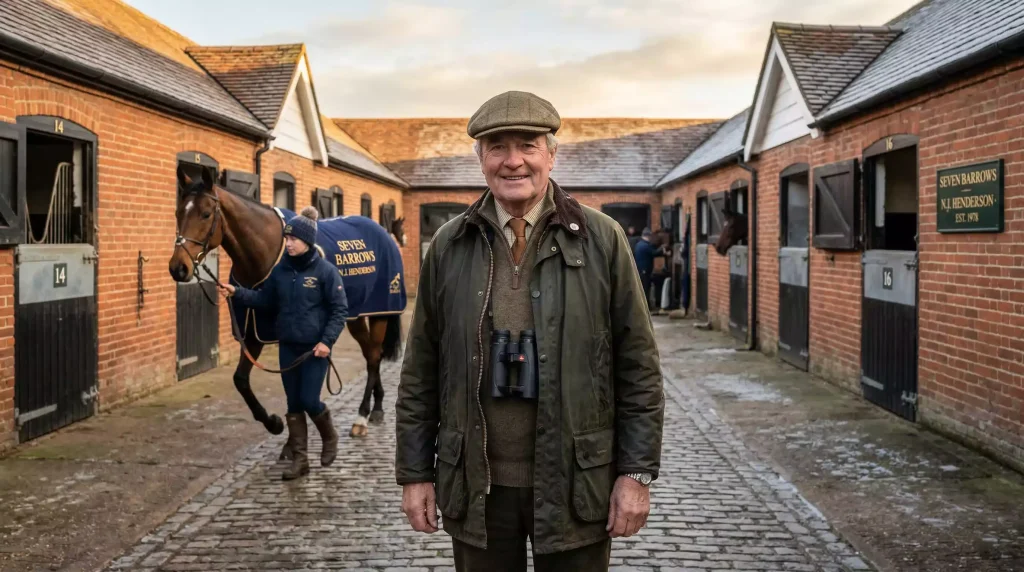
The Other Champion
Nicky Henderson exists in Paul Nicholls’ shadow at the King George—yet this framing undersells one of National Hunt racing’s most successful trainers. Henderson has won multiple King Georges, multiple Champion Trainer titles, and shaped jump racing for four decades from his Seven Barrows base in Lambourn.
The rivalry with Nicholls defines both men’s legacies. Nicholls leads the King George count; Henderson leads in other metrics. Their Boxing Day encounters over twenty-plus years created narratives that transcended individual races. The eternal contender label fits Henderson only if you ignore his victories; his record demands respect independent of comparison.
As Henderson himself observed about Kempton after the 2026 King George: “You will never see a better horse race, and it’s why we need Kempton. Whoever wants to knock this place down must be barking mad!” The passion reflects genuine connection—Henderson has built Kempton memories that justify his status as a King George contender year after year.
Nicky Henderson King George Record — More on this topic at king george betting.
King George Wins
Henderson has won the King George VI Chase three times—with Long Run in 2010 and 2012, and Might Bite in 2017. While this tally falls short of Paul Nicholls’ thirteen victories, it represents sustained excellence at the highest level against fierce competition.
Long Run delivered two victories that bookended Kauto Star’s final triumph. The 2010 King George (run in January 2011 due to weather postponement) saw Long Run end Kauto Star’s four-year reign with an eight-length demolition. This performance announced a new force in staying chasing and positioned Long Run as the coming power.
Kauto Star reclaimed his crown in 2011’s renewal, beating Long Run by one and three-quarter lengths at eleven years old—one of the great King George performances. Long Run returned to winning form in 2012, demonstrating resilience after that defeat and confirming his class across multiple seasons. Both horses’ careers became intertwined through their Kempton encounters.
Might Bite’s 2017 victory came at 6/4 favourite, giving Henderson his most recent King George success. The horse won by a length and a quarter under Nico de Boinville, adding another Kempton triumph to Henderson’s record. Might Bite’s front-running style suited the track’s demands perfectly.
Henderson’s three King George wins span seven years rather than clustering in a single era. This distribution reflects sustained competitiveness at the top level—the ability to produce different horses capable of winning jump racing’s premier mid-season target across changing eras.
The Long Run Era
Long Run arrived at Seven Barrows with exceptional credentials from his previous trainer—a point-to-point background and chasing education that suggested top-class potential. Henderson recognised what others had developed and prepared the horse for championship targets.
The 2010 King George (run on 15 January 2011 after the Christmas meeting was lost to snow) ended Kauto Star’s four-year reign. Long Run beat the reigning champion by eight lengths, a margin suggesting complete superiority rather than lucky circumstances. Henderson had trained a horse capable of defeating the best chaser of the modern era at his peak.
The 2011 King George delivered drama that scripted entertainment rarely matches. Kauto Star, aged eleven, mounted an extraordinary comeback to reclaim his crown. He beat Long Run by one and three-quarter lengths in what many consider one of the race’s finest renewals. Henderson’s horse ran with credit—finishing second to a legend finding one final peak.
Long Run returned to claim the 2012 King George, avenging his previous defeat. This victory under amateur Sam Waley-Cohen proved the horse’s quality wasn’t dependent on catching an ageing champion. Long Run had established his own King George legacy independent of his rival.
The Long Run era proved Henderson could compete with Nicholls’ best when conditions aligned. The 2010 victory dethroned Kauto Star; the 2012 success demonstrated sustained excellence. That Long Run also won the 2011 Cheltenham Gold Cup confirmed him as a complete staying chaser whose Kempton performances represented one dimension of broader championship quality.
Training Philosophy
Henderson’s approach to King George preparation emphasises freshness over race-hardened fitness. His horses typically arrive at Kempton having run once or twice in the autumn rather than competing fortnightly throughout November and December. The approach sacrifices race sharpness for physical reserve.
Seven Barrows’ facilities support this methodology. The gallops, schooling grounds, and recovery infrastructure allow horses to reach peak condition through training rather than racing. Henderson trusts his home preparation; he doesn’t need competitive outings to gauge fitness when his trackwork tells the story.
The approach creates ante-post uncertainty. A Henderson horse targeting the King George might not have shown its best form in autumn prep races—deliberately held back rather than inadvertently underperforming. Punters who judge on recent form sometimes underestimate Seven Barrows runners who’ve been prepared specifically for Boxing Day rather than chasing wins throughout the autumn.
Henderson’s longevity reflects adaptability within consistent principles. Methods that worked in the 1980s have evolved to incorporate modern sports science, but the core philosophy—produce a fresh, healthy horse on Boxing Day—remains unchanged. The King George rewards horses who’ve been trained toward a specific target; Henderson has done this successfully for over forty years.
Staff continuity supports the approach. Long-serving team members understand how Henderson wants horses prepared, reducing communication friction that can undermine complex training plans. The stable operates as an institution rather than an individual enterprise, with accumulated knowledge passing between generations of workers.
Current Stable Prospects
Henderson’s 2026 King George plans depend on how his staying chase division develops through the autumn. Seven Barrows maintains depth at the top level; identifying which horses merit Boxing Day assignment requires assessing autumn form against Kempton’s specific demands.
The stable’s strength in two-mile chasing sometimes obscures three-mile potential. Henderson excels at producing Champion Chase types—speed chasers who dominate at shorter trips. Staying chasers get less attention despite Henderson’s King George pedigree. The yard’s three-mile horses deserve scrutiny even when headline attention focuses elsewhere.
Young chasers stepping up from novice ranks occasionally emerge as King George contenders. Henderson’s patient development—allowing horses to mature physically before demanding championship performances—sometimes produces late-season revelations. A novice who’s been given time might peak at precisely the right moment for Boxing Day.
Jockey Nico de Boinville’s commitment signals stable confidence. When de Boinville books a specific Henderson runner for the King George—rather than choosing between options—the decision reflects internal assessment of genuine winning chance. Jockey choices often telegraph trainer expectations more clearly than public statements.
Henderson’s age prompts speculation about succession planning, but his continued hands-on involvement ensures Seven Barrows operates at full capacity. The King George remains a target; the stable maintains horses capable of winning it. Whether 2026 delivers depends on specific horse development, but Henderson’s King George ambitions remain active.
Henderson vs Nicholls Head-to-Head
The numbers favour Nicholls convincingly. Thirteen King George victories to Henderson’s three creates a gap that head-to-head records can’t close. Nicholls has dominated the race across three decades; Henderson has interrupted that dominance rather than matched it.
Yet context complicates simple comparison. Nicholls’ Somerset operation—Manor Farm Stables—was built specifically around National Hunt racing’s biggest prizes. Henderson’s Seven Barrows balances King George ambitions against Champion Hurdle contenders, Champion Chase types, and development horses. The stables operate with different strategic emphases.
Champion Trainer title races have fluctuated between them. Henderson has won multiple championships; Nicholls has won more. The King George contributes to championship races without determining them—prizemoney from Boxing Day helps, but season-long consistency matters more. Henderson’s championship seasons came despite Nicholls’ King George dominance.
The rivalry benefits both trainers commercially. Owners seeking King George success might choose Nicholls on statistical grounds; those wanting broader championship campaigns might prefer Henderson’s diversity. Competition keeps both yards sharp, pushing standards upward across British jump racing.
Respectful rivalry characterises their public interactions. Neither diminishes the other; both acknowledge competitor excellence while backing their own chances. The King George on Boxing Day crystallises their competition annually—the same race, the same conditions, the same prize. Nicholls leads; Henderson competes credibly. The eternal contender label might understate Henderson’s achievements, but it accurately describes his position relative to Nicholls at Kempton specifically.
See also Willie Mullins and the King George Quest.
