
Visiting Kempton on Boxing Day
 Available in US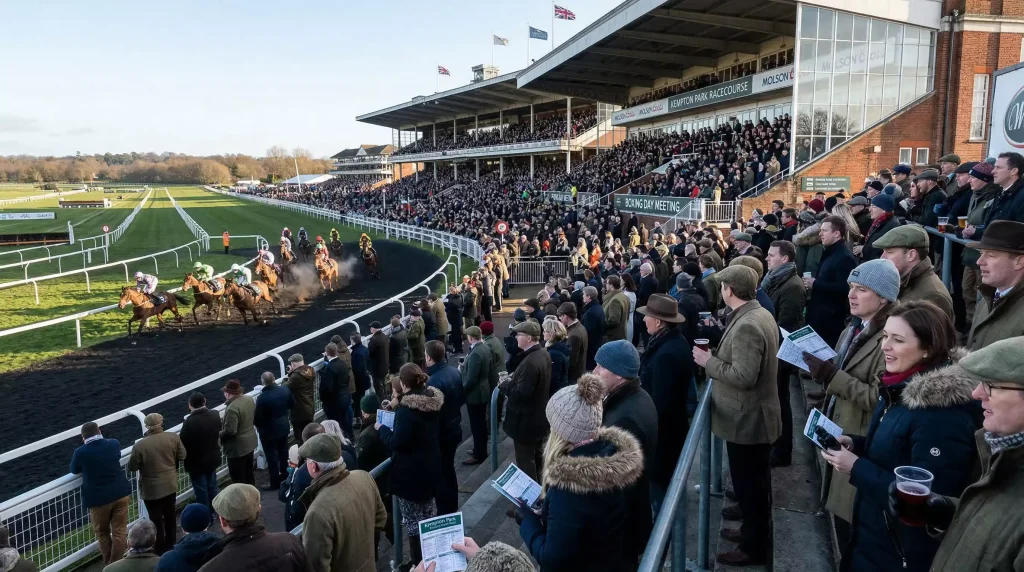
The Boxing Day Experience
Attending the King George in person offers something television cannot replicate. The atmosphere, the crowd energy, the visceral thunder of horses approaching the final fence—these elements transform a sporting event into an experience. Your Boxing Day at the races becomes a memory rather than mere viewing.
Kempton welcomed 17,195 racegoers for the 2026 King George, an increase of 3,332 from the previous year. The growth suggests renewed appetite for live racing after years of declining attendance. Boxing Day draws crowds who might not attend racing otherwise—families escaping domestic cabin fever, couples seeking festive entertainment, groups continuing Christmas celebrations into the following day.
The practical reality involves planning. Tickets, transport, clothing for December weather, navigation of on-course facilities—these logistics determine whether the experience delights or disappoints. This guide covers what you need to know before committing to Kempton rather than your sofa.
Visiting Kempton on Boxing Day — More on this topic at king george betting.
Ticket Types and Prices
Kempton offers tiered admission reflecting different viewing experiences and budgets. General admission provides racecourse access without reserved seating or premium facilities—standing room at rails, access to public bars and betting areas, and full participation in the day’s atmosphere at the lowest price point.
Premier enclosure tickets add covered viewing areas and marginally better facilities. The price increase over general admission is modest; the benefits depend on weather conditions. On a dry Boxing Day, general admission might suffice. In rain or cold, covered areas justify the upgrade.
Annual badge holders access the racecourse through membership schemes. These season-ticket equivalents work out cheaper for regular attendees but represent commitment beyond a single Boxing Day visit. If you’re testing whether live racing suits you, general or Premier tickets make more sense than annual membership.
Children’s pricing varies by age bracket—free entry for under-fives is standard, with reduced rates extending through teenage years. Family groups benefit from checking specific age thresholds before budgeting; a family of four might pay significantly different totals depending on children’s ages.
Advance booking typically secures discounts against gate prices. Boxing Day sells out or reaches capacity in strong years; booking ahead guarantees admission while reducing cost. The Jockey Club website—Kempton’s parent organisation—handles ticket sales with straightforward online booking.
Avoid touts selling tickets at inflated prices near the racecourse. Legitimate tickets come through official channels; third-party resales carry fraud risk and violate terms that could void entry. If the official channels show sold out, consider whether the premium genuinely reflects value or exploits demand.
Getting to Kempton
Kempton Park Racecourse sits in Sunbury-on-Thames, Surrey—accessible from London but not central. Transport options suit different starting points and preferences.
By train, Kempton Park station sits adjacent to the racecourse. South Western Railway operates services from London Waterloo, with journey times around 30-40 minutes. Boxing Day train services run on reduced schedules; check National Rail timetables specifically for December 26 rather than assuming normal service. Return trains after racing finish can become crowded; allowing time avoids crushing onto packed carriages.
By car, the M3 and A308 provide access from various directions. Kempton offers on-site parking included with Premier tickets or available for purchase with general admission. Arriving early secures convenient parking; arriving close to first race means longer walks from distant car park areas. Satnav navigation to the main entrance works reliably.
Boxing Day traffic around Kempton can congest, particularly after racing when everyone leaves simultaneously. Building extra time into return journeys prevents frustration; alternatively, extending your stay for a post-racing drink allows traffic to clear before departure.
Taxi services operate from the racecourse, though demand after the last race exceeds supply. Pre-booking return transport or using ride-hailing apps improves reliability. Walking to Kempton Park station remains the simplest exit strategy for many attendees.
On-Course Facilities
Kempton provides standard racecourse amenities—bars, food outlets, toilets, betting facilities—across accessible locations. The facilities aren’t luxurious by modern stadium standards but serve their purpose for a day’s racing.
Multiple bars operate throughout the racecourse, offering beer, wine, spirits, and soft drinks. Prices reflect captive-audience economics—expect to pay more than pub rates. The queues build around race times as punters seek liquid courage or celebration; buying between races reduces waiting.
Food options range from basic fast-food fare to sit-down restaurants depending on enclosure access. Burgers, fish and chips, and similar racecourse staples dominate the accessible outlets. Premier and hospitality areas offer upgraded catering. Bringing snacks isn’t prohibited for general admission—sandwiches from home supplement expensive on-site options.
The betting ring hosts on-course bookmakers offering track-side prices. Comparing board prices against mobile app odds sometimes reveals value; on-course bookies occasionally offer marginally better prices than their digital counterparts. Cash remains standard for on-course betting, though card acceptance is increasing.
Tote windows provide pool betting access for those preferring that format. The trackside Tote experience—completing paper slips, watching dividends announced—carries nostalgic appeal even as mobile betting dominates modern racecourse wagering.
Toilet facilities are adequate if not abundant. Queues develop at peak times, particularly between high-profile races. Planning bathroom breaks around race timing rather than during pre-race rushes improves the experience.
Best Viewing Spots
The grandstand provides elevated views of the finishing straight and winning post. Arriving early secures prime position; latecomers find themselves peering over shoulders or settling for peripheral angles. For the King George specifically, grandstand positioning offers the best view of the final fence approach and dramatic finish.
Rail-side positions near the final fence attract those wanting proximity to the action. You’ll hear hooves, feel ground vibration, and experience speed that television cannot convey. The trade-off: you see only the section directly in front, missing the race’s broader tactical picture visible from elevated positions.
The paddock area rewards different priorities—seeing horses up close before racing, assessing condition and temperament, watching jockeys mount and receive instructions. Paddock viewing complements rather than replaces finishing-line positioning. Moving between locations across the card lets you experience both.
Large screens positioned around the course relay television coverage for those distant from live action. The hybrid experience—watching screens while hearing actual crowd noise—suits casual attendees less focused on optimal viewing angles.
Hospitality Packages
Kempton offers hospitality packages for those wanting elevated Boxing Day experiences. These combine premium viewing, inclusive catering, and private facilities at prices reflecting the additional service.
Restaurant packages provide sit-down meals with course views—champagne reception, multi-course lunch, afternoon tea, and privileged access areas. The all-inclusive pricing removes uncertainty about spending; everything is covered except personal betting. Groups celebrating Boxing Day as a special occasion often find hospitality packages justify the premium.
Private boxes suit corporate entertainment or large groups seeking exclusive space. The boxes offer privacy, dedicated service, and viewing platforms shared only with your party. Prices scale with group size and box location; booking months ahead secures availability for popular fixtures like the King George.
Hospitality dress codes typically exceed general enclosure standards. Smart casual represents minimum; suits and dresses remain appropriate without appearing overdressed. Checking specific package requirements before purchasing prevents wardrobe emergencies.
The value proposition depends on priorities. If you’re attending primarily for racing—betting, watching, analysis—general admission delivers the core experience at a fraction of hospitality costs. If the social occasion matters as much as the sport—impressing clients, celebrating occasions, enjoying luxury—hospitality packages enhance accordingly. Both approaches are valid; neither is objectively superior.
Dress Code and Tips
December weather dictates practical clothing choices. Layers work better than single heavy garments—temperatures vary between exposed viewing areas and heated indoor spaces. Waterproof outer layers protect against showers without requiring premature retreat indoors.
Footwear matters significantly. Kempton’s grass areas become muddy after rain; unsuitable shoes ruin the day. Wellington boots or sturdy waterproof footwear with grip suit typical Boxing Day conditions. Fashion considerations yield to practicality at winter racecourses.
General enclosure dress codes are relaxed—smart casual suffices, with no formal requirements. Jeans and trainers won’t attract comment or refusal. Premier enclosures suggest slightly smarter attire without mandating suits or dresses.
Bring cash for on-course bookmakers and some food outlets where card acceptance remains inconsistent. A fully charged phone ensures access to betting apps and streaming backup if queues prevent live viewing. Portable phone chargers extend battery life through full race days.
Consider bringing binoculars for detailed viewing across the course. The track’s layout means distant action—backstraight jumping, for instance—appears small from grandstand positions. Binoculars reveal jumping technique and travelling comfort that naked eyes miss.
Arriving early maximises the experience. First races start around noon; arriving by 11am allows position-claiming, familiarisation, and relaxed preparation. Late arrival means compromise on viewing positions and rushed acclimatisation to an unfamiliar venue.
See also King George VI Chase History and Origins.
