
Each-Way Betting on King George VI Chase
 Available in US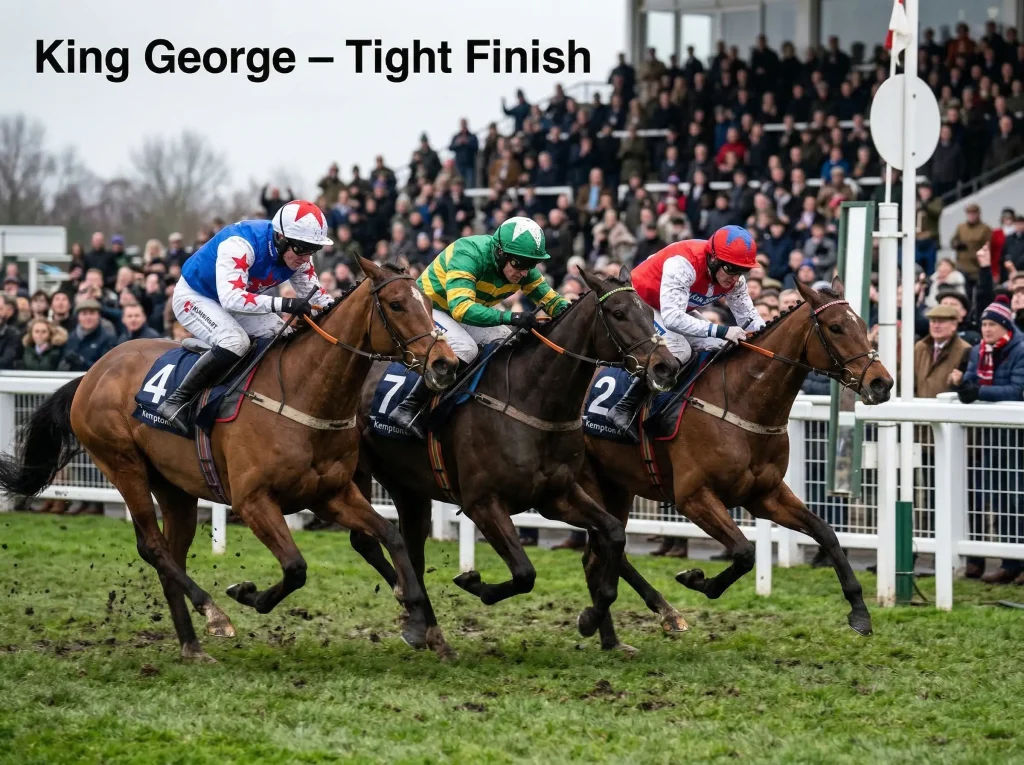
Each-Way Basics
Each-way betting places two equal stakes on the same selection: one to win, one to place. If your horse wins, both bets pay out. If it finishes second or third—depending on the race—only the place bet returns. If it finishes outside the places, both stakes lose.
The appeal is obvious: reduced risk on horses you fancy but don’t fully trust to win. The smart way to back outsiders who might run into a place without quite taking the prize. In a quality field like the King George, where any of four or five horses might win, each-way betting offers insurance against backing the right animal in the wrong position.
But each-way isn’t automatically better than win-only. The mathematics depend on field size, place terms, and your horse’s actual chance of placing versus winning. Getting this wrong costs money over time. Each-way betting suits specific scenarios—understanding which ones separates clever punting from expensive habit.
Each-Way Betting on King George VI Chase — More on this topic at king george betting.
Place Terms for King George
Place terms define what fraction of the win odds you receive for a place finish, and how many places pay. For the King George, the typical offering is three places at one-quarter the odds. This means a horse backed at 12/1 returns 3/1 (12 divided by 4) for finishing second or third.
Three places at quarter odds represents standard terms for non-handicap jumps races with adequate field sizes. The King George usually attracts eight to twelve runners, comfortably within the threshold for three places. With fewer than five runners, most bookmakers reduce terms to two places—sometimes just winner-takes-all.
Some operators enhance terms around major festivals. Boxing Day occasionally sees promotions offering four places or one-fifth odds (12/1 becomes 2.4/1 for a place) on selected races. These enhanced terms shift the mathematics substantially. A horse at 10/1 paying four places at one-fifth odds suddenly offers genuine value that standard terms wouldn’t justify.
Prize money distribution for the King George itself—first place takes £148,098 of the £260,050 total purse—reflects how steeply weighted toward winners the race economics work. Second and third receive progressively smaller shares. The betting market’s place terms roughly mirror this distribution: you’re paid less because the race rewards winners disproportionately.
When comparing bookmaker offers, note that terms might differ between operators on the same race. One bookmaker offering four places while another offers three creates a clear preference for place-only bets on outsiders. The win-only market shows less variation; place terms are where savvy bettors find edges.
Check terms before betting, every time. Assumptions based on previous years or other races lead to unpleasant surprises when your 14/1 shot finishes third and returns less than you calculated.
Field Size Impact
Field size determines both place terms and your actual chances of collecting. Jump racing’s average field size sits at 7.84 runners according to BHA’s 2026 Racing Report—smaller than flat racing’s 8.90. The King George typically runs with eight to twelve declared runners, occasionally fewer in weak renewal years.
With eight runners paying three places, 37.5% of the field earns place money. At twelve runners, that drops to 25%. The maths might seem marginal, but your outsider’s place probability shifts meaningfully between these scenarios. An 8/1 shot in a field of eight has different place equity than the same price in a field of twelve.
Small fields dramatically alter each-way value. If only five horses run, bookmakers typically offer two places instead of three. Your 10/1 outsider now needs to beat more of the field proportionally to place. The each-way calculation that looked attractive at three places might not work at two.
Late withdrawals can move you between term thresholds. Betting each-way at 10/1 expecting three places, then watching two horses withdraw the morning of the race, might leave you with reduced terms. Some bookmakers honour the terms available when you placed the bet; others apply race-time terms. Understanding your bookmaker’s policy prevents Boxing Day disappointment.
Bigger fields favour each-way bets on outsiders. When fifteen runners fight for three places, a 25/1 shot has meaningful place equity that a win-only bet ignores. The King George rarely sees fields this large, but Boxing Day’s supporting races might—adjusting strategy race by race makes sense.
Field size also affects how favourites perform. In small fields, class tells more cleanly; in larger fields, pace and luck introduce variability. Your each-way bet on a 6/1 second-favourite might have better place chances in a larger field where the favourite faces more traffic problems.
Calculating Each-Way Returns
Each-way returns involve two separate bets, so double your intended stake when budgeting. A £10 each-way bet costs £20 total: £10 on the win, £10 on the place.
If your horse wins at 8/1 with one-quarter the odds for places: the win bet returns £80 profit plus your £10 stake. The place bet pays 2/1 (8 divided by 4), returning £20 profit plus your £10 stake. Total return: £120 from a £20 outlay. Not quite the £80 profit a £20 win-only bet would have returned, but acceptable insurance for an uncertain outcome.
If the same horse finishes second: the win bet loses its £10 stake. The place bet returns £20 profit plus £10 stake. Total return: £30 from £20 outlay, netting £10 profit. Without the each-way structure, you’d have lost £20 on a win-only bet.
If the horse finishes fourth or worse: both stakes lose. Your £20 disappears regardless of how close fourth place was. Each-way isn’t partial insurance—it’s a binary outcome for the place portion.
Break-even analysis reveals where each-way becomes profitable. For a horse at 8/1 (three places, quarter odds), each-way beats win-only if the horse places without winning often enough to compensate for the reduced win returns. Run the numbers for your specific selection: if you believe the horse places 60% of the time but wins only 20%, each-way likely offers better expected value than win-only. If winning probability is 25% and placing 30%, the margin is closer—and might favour win-only at these odds.
When Each-Way Beats Win-Only
Each-way betting outperforms win-only in specific circumstances. Understanding these scenarios improves returns more than any system or tip sheet.
Outsiders with place credentials represent the classic each-way proposition. A horse at 14/1 who consistently finishes in the frame but rarely wins offers genuine place value. If you assess its place probability at 40% and win probability at 10%, the place odds of 3.5/1 (14 divided by 4) massively overestimate what you should actually pay. Each-way captures this edge; win-only ignores it.
Competitive races with multiple contenders suit each-way approaches. When five horses trade between 4/1 and 8/1, predicting the winner becomes largely guesswork—but predicting which of them will place is easier. The King George often presents exactly this scenario: clear class horses separated by margins that might come down to jockey decisions, racing luck, or how each handles the ground that particular Boxing Day.
Horses stepping up in class sometimes merit each-way support. A progressive chaser taking on established Grade 1 performers might struggle to win outright but could run into third against inferior opposition while gaining experience. The place bet hedges the optimistic win selection.
Each-way betting suits uncertain ground conditions too. If your selection excels on soft ground and the forecast is changeable, each-way protects against conditions not quite suiting while still capturing value if they do.
The worst each-way bets involve short-priced favourites. Backing a 2/1 shot each-way at quarter the odds means your place bet pays just 1/2—barely worth the stake if it finishes second. Below about 5/1, each-way seldom makes mathematical sense unless enhanced place terms apply. Win-only or avoid entirely becomes the sensible choice.
Each-Way Accumulators
Each-way accumulators split into two separate multiples: a win accumulator and a place accumulator. Both legs of each selection must succeed for that portion to continue. Confused? You’re not alone.
In a four-horse each-way accumulator, if all four win, both accumulators pay out—generating massive returns. If three win and one places, the win accumulator dies but the place accumulator survives if that runner also placed. If one horse finishes fourth, the place accumulator dies too; you’re left with whatever the win acca returned from winners before the failure.
The mathematics quickly become unwieldy. Each-way accumulators compound both risk and potential return. Four horses at 8/1 each, all winning, returns astronomical figures. But the likelihood of four horses all winning in competitive races is minimal—and the place safety net requires all four to place, which isn’t much more likely.
For Boxing Day betting, smaller each-way multiples offer more practical use. A treble covering two Kempton races and one Wetherby selection captures upside while maintaining some place insurance. The place leg might return your stake if two place and one wins—not exciting, but better than a losing win-only treble.
Be wary of bookmaker promotions on each-way accumulators. Extra places or improved terms sound generous but often come with maximum payout caps or void conditions that erode value. Read terms carefully; the headline offer frequently looks better than the actual mathematics.
If you’re committed to each-way accas, stick to three or four selections maximum. Beyond that, complexity overwhelms potential benefits, and you’re essentially buying lottery tickets with extra steps.
See also King George Free Bets and Offers 2026.
