
King George VI Chase Odds 2026: Ante-Post Prices and Market Movements
 Available in US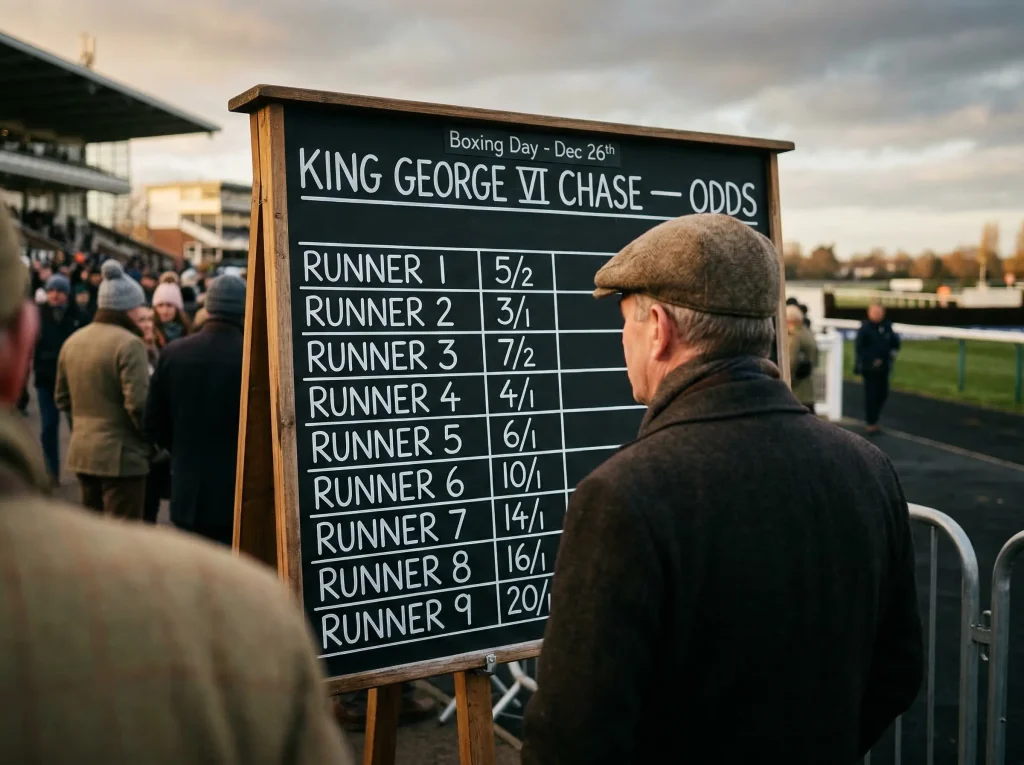
Reading the King George Market
The King George VI Chase odds tell a story long before the Boxing Day tapes rise at Kempton Park. This market operates differently from most Grade 1 chases, shaped by timing, tradition, and the peculiar demands of Britain’s premier mid-season staying chase. Understanding how to read these prices separates shrewd punters from casual backers throwing darts at a racecard.
Where the smart money goes in the King George market depends on recognising patterns invisible to those who only check odds on race morning. The ante-post market opens months before December, evolving through the autumn trials at Wetherby, Haydock, and Down Royal. Each result ripples through the prices, sometimes logically, often not. The UK Gambling Commission reports remote betting gross gaming yield on horse racing reached £766.7 million in 2026-25, second only to football. A substantial portion of that National Hunt money flows through prestige events like the King George, where ante-post activity begins in earnest once the previous season ends.
Total prize money for the 2026 King George stands at £260,050, with the winner collecting £148,098. These figures attract the highest-calibre staying chasers in training, guaranteeing competitive fields and markets with genuine depth. But depth alone does not equal value. The skill lies in identifying where bookmakers have mispriced a runner, where sentiment has pushed a horse too short, or where a drifter deserves closer inspection rather than dismissal.
This analysis breaks down the current market layer by layer: where prices stand, how they have shifted, and what those movements reveal about genuine confidence versus public money chasing names.
King George VI Chase Odds 2026 — More on this topic at king george betting.
Current Ante-Post Odds
The ante-post market for the 2026 King George has crystallised around a familiar pattern: one or two short-priced contenders, a cluster of single-digit outsiders, and a long tail of hopefuls priced at 20/1 and beyond. Reading this market requires understanding what the layers reveal and where they might be wrong.
At the head of the market, prices typically compress as Boxing Day approaches. Early-season quotes of 5/1 on a well-regarded runner can shorten to 9/4 following a convincing trial win. Conversely, a lacklustre performance or minor setback sends prices drifting from 8/1 out to 16/1 within days. The King George market is particularly sensitive to prep race results because the race arrives early in the season—only a handful of competitive chases separate the summer break from Boxing Day.
Comparing prices across bookmakers reveals telling discrepancies. The major firms often agree within a point or two on market leaders, but further down the betting, gaps of 25% or more in implied probability are common. A horse available at 12/1 with one bookmaker and 16/1 with another represents a significant edge for alert punters. These discrepancies occur because each firm balances its book differently, reacting to different customer bases and liability positions.
The exchange market, primarily Betfair, provides another reading. Exchange prices typically run slightly longer than bookmaker odds on favourites but tighter on outsiders. When a horse trades consistently shorter on the exchange than in bookmaker markets, that signals professional money. The exchange reflects unfiltered supply and demand, stripped of the margin bookmakers build into their odds.
Ante-post punters should note that odds quoted in November may bear little resemblance to starting prices on Boxing Day. The 2026 winner came from outside the top three in the early market, a reminder that ante-post charts capture a moment rather than destiny. The value lies not in predicting the eventual winner but in identifying mispriced runners at the point of betting.
Timing matters enormously. Odds available the day after the Betfair Chase at Haydock often offer the best window—outcomes have reshuffled perceptions, but the full market adjustment takes 24 to 48 hours. Sharp operators recognise this lag and act quickly.
Price Movement Tracker
Price movements in the King George market follow a rhythm tied to the National Hunt calendar. Understanding this rhythm helps distinguish meaningful signals from noise.
The opening of the ante-post market in late spring establishes baseline prices based on previous season form and stable reports. These initial odds are soft—bookmakers test the water without excessive liability. A fancied horse might open at 8/1, attractive enough to generate early interest while leaving room to shorten if stable confidence proves warranted. Movement in this phase reflects industry intelligence more than public money.
The first significant recalibration occurs after the autumn trials. The Charlie Hall Chase at Wetherby, the Betfair Chase at Haydock, and the John Durkan at Punchestown all reshape the market. Winners from these races typically shorten two or three points; beaten favourites drift substantially. The degree of movement depends on the manner of victory or defeat. A comprehensive ten-length success triggers sharper adjustment than a narrow, grinding win. Similarly, a gallant second beaten half a length in heavy ground might barely move the needle, while an unexplained disappointing run causes pronounced drift.
Tracking these movements over the past decade reveals a pattern: horses that shorten steadily from October into December perform better than those whose prices collapse suddenly after a single impressive run. Steady support suggests accumulating confidence across multiple informed sources. A sudden plunge often reflects public reaction to a visual spectacle rather than cold assessment of Boxing Day credentials.
Steamers—horses whose odds contract rapidly in the final weeks—demand scrutiny. Sometimes the move reflects genuine yard confidence reaching the market late. Other times, it represents less sophisticated money chasing a story. Distinguishing between these requires checking whether the move originated on exchanges, where professional punters operate, or solely in recreational bookmaker markets.
Drifters attract less attention but merit more. A horse easing from 6/1 to 10/1 might signal concerns within the yard, or it might simply reflect money arriving for a rival. Cross-referencing with stable news, jockey bookings, and trial entries helps diagnose the cause. Genuine concerns warrant caution. Drift caused by support for others sometimes creates value on a horse whose fundamentals remain intact.
Price movements on the morning of Boxing Day can be explosive. Late money often arrives for trainers with strong Kempton records, particularly Paul Nicholls, whose 13 King George victories have conditioned the market to expect his runners to perform. This final hour activity can compress prices by 20% on fancied runners while others drift without genuine negatives emerging.
Each-Way Betting Analysis
Each-way betting on the King George requires understanding how field size transforms the mathematics. The race typically attracts between seven and twelve runners, a range that fundamentally shapes whether each-way betting offers value or merely splits your stake inefficiently.
Standard terms for the King George are quarter the odds for three places when eight or more runners go to post. With smaller fields, some bookmakers reduce to two places or offer fifth odds rather than quarter odds. These adjustments significantly alter the proposition. At quarter odds for three places, an each-way bet on a 12/1 shot returns your stake if the horse finishes second or third, plus the place portion of your bet at 3/1. Drop to fifth odds for two places, and that same 12/1 shot pays only 2.4/1 for a place—a substantial reduction.
The BHA Racing Report 2026 recorded average field sizes of 7.84 runners for Jump races. The King George typically falls at or slightly above this average. With fields hovering around eight runners, the each-way market enters a grey zone—some firms pay three places, others two. Checking terms across multiple bookmakers before committing becomes essential.
Field size interacts with the shape of the market to determine each-way value. In a race with two short-priced market leaders and a wide-open battle for third, each-way bets on mid-priced outsiders carry extra appeal. The place portion of the bet effectively becomes a wager on beating horses with similar profiles rather than competing against the outright favourites. Conversely, when three or four horses trade at similar short prices, the scramble for places intensifies, reducing the probability that your selection earns a place return.
Historical King George results show outsiders hitting the frame regularly. Horses priced between 10/1 and 20/1 have finished second or third with surprising frequency over the past fifteen years, making the place component of each-way bets a genuine asset rather than insurance. This pattern reflects the nature of the race—a stamina test that occasionally exposes overhyped class horses while rewarding relentless galloping types that outrun their price.
One angle worth exploring: Best Odds Guaranteed on each-way bets. If you take 14/1 each-way in the morning and the starting price drifts to 20/1, firms offering BOG pay the win portion at 20/1 and the place at 5/1. Not all bookmakers extend BOG to the place portion—check the small print. Those that do offer a subtle but consistent edge over the long term.
Bookmaker Market Depth
Market depth measures how much money a bookmaker will accept at quoted odds before adjusting prices. For major betting events like the King George, this matters enormously. A punter seeking to place £500 needs a different strategy than one wagering £20.
Traditional bookmakers generally offer thinner markets than exchanges. A high street firm might accept a £50 or £100 bet at advertised odds before trimming the price for subsequent wagers. The larger online operators typically show better depth, accepting four-figure stakes on established prices for Grade 1 races. However, accounts flagged as profitable or sharp often face restrictions regardless of the event’s prestige.
Betfair and other exchanges operate differently. The price you see represents money available at that level. If £2,000 is available to back at 8.0 on the exchange, you can take the full amount. Beyond that, you hit the next layer of the market at shorter odds. Exchange depth fluctuates throughout the day as backers and layers enter and exit. Mornings tend to show thinner markets than afternoons, and the final hour before post time sees the deepest liquidity as late money arrives.
Spread across multiple bookmakers becomes the practical solution for substantial wagers. Taking £200 at 10/1 with five different firms achieves better overall odds than negotiating with one bookmaker whose price will contract after an initial £500 stake. This approach also captures Best Odds Guaranteed benefits if any firm’s SP exceeds the price taken.
For the King George specifically, market depth increases as Boxing Day approaches. Ante-post markets in October might struggle to accommodate significant volume without price moves. By mid-December, firms are building their books and actively seeking liability, offering better depth and occasionally enhanced prices to balance positions.
Shrewd punters monitor where large sums are matched on exchanges. If a horse suddenly shows £10,000 or more traded at a specific price, someone with access to information has acted. Exchange transparency reveals these moves in real time. Bookmaker markets obscure them, adjusting prices after the fact without indicating how much money triggered the change.
Non-Runner No Bet Explained
Non-Runner No Bet offers exist specifically because ante-post betting carries withdrawal risk. A horse you back in October might never make it to Boxing Day. Understanding NRNB terms transforms how you approach the King George market.
Standard ante-post rules are straightforward and unforgiving: if your horse does not run, you lose your stake. This reflects the higher prices available in ante-post markets—bookmakers offer better odds because they bear less risk of paying out on horses that fail to make the race. The earlier you bet, the more can go wrong, and bookmakers price that uncertainty into their odds.
NRNB promotions alter this equation. When a bookmaker offers Non-Runner No Bet on the King George, they refund stakes if your selection does not start. These offers typically come with restrictions. The most common: NRNB applies only to specified horses, usually the market leaders. A promotion might cover the top six in the betting while standard rules apply to longer-priced runners. Other restrictions include maximum stakes, new customer only terms, or requirements to bet at least seven days before the race.
The value calculation changes with NRNB. Ante-post odds compensate for withdrawal risk. With that risk removed, the price effectively becomes equivalent to day-of-race betting—except you’ve locked it in weeks earlier, possibly before a price collapse. An 8/1 shot that shortens to 4/1 by Boxing Day represents tremendous value if you secured that price with NRNB protection.
Timing NRNB bets requires balance. Offers typically appear from late November, giving perhaps three to four weeks of coverage. Betting too early means missing the protection entirely. Betting too late might mean prices have already contracted following trial results. The optimal window often opens immediately after the Betfair Chase at Haydock in late November, when NRNB becomes available and the market is still adjusting to autumn form.
Watch for horses whose King George participation seems uncertain. A runner with options at Leopardstown or Limerick over Christmas might skip Kempton if ground conditions or logistics favour Ireland. With NRNB, backing such horses costs nothing if they redirect elsewhere. Without it, the uncertainty argues for waiting until declarations confirm participation. Cross-referencing trainer comments and stable tours helps identify which horses are firmly committed to the Boxing Day target.
One note of caution: NRNB applies to non-runners before the race starts. If your horse falls at the first fence or pulls up lame during the race, normal rules apply. The protection covers only the withdrawal scenario, not the race itself.
Value Identification
Value in betting exists when the probability of an outcome exceeds what the odds imply. Identifying value in the King George market requires divorcing analysis from narrative and focusing on cold probabilities.
The first step is converting odds to implied probabilities. A horse at 4/1 carries an implied probability of 20%. At 8/1, it drops to 11.1%. These percentages form the baseline for comparison. Your task is estimating actual probability based on form analysis, then betting only when your figure exceeds the market’s.
Form analysis in the King George context means assessing recent performances through multiple lenses. Raw finishing positions matter less than the manner of running. Did the horse travel strongly before fading, suggesting stamina doubts? Did it pull hard early, wasting energy that cost it late? Did it jump fluently or make errors that better courses might punish? Kempton’s flat, right-handed track with eighteen fences over three miles rewards particular attributes. Horses that excel here may have underperformed on more demanding tracks, offering prices that underrate their Boxing Day credentials.
The state of the broader market affects value calculations. As Paul Darling OBE KC, the late Chairman of the Horserace Betting Levy Board, observed in his analysis: “The trend that was seen towards the end of 2022-23 has continued. Betting turnover is lower and bookmakers’ profits higher than recent norms.” When bookmakers enjoy higher margins, they can afford to offer slightly less competitive prices across the board. This market context means punters must work harder to find genuine edges.
Overpriced runners often share characteristics. Horses returning from layoffs, even successful ones, tend to drift in the market as punters question match fitness. Second-season chasers stepping up in class attract scepticism about handling Grade 1 intensity. Irish raiders face doubts about handling British conditions or travelling logistics. Each of these concerns might be valid, or might represent market inefficiency worth exploiting.
Underpriced runners follow their own patterns. Previous King George winners command excessive loyalty—punters remember Desert Orchid and Kauto Star, subconsciously elevating any repeat contender. Paul Nicholls runners typically trade shorter than form warrants, reflecting his extraordinary record rather than objective assessment of that specific horse. The market leader often shortens beyond value simply because recreational punters default to backing the favourite.
Cross-referencing with tissue prices helps. Racing publications release their own assessments, as do professional tipsters and betting analysts. Where multiple independent sources agree on a price significantly different from market quotes, investigate why. Sometimes the market knows something these assessors don’t. Often, it doesn’t.
Historical Odds vs Results
History offers a laboratory for testing betting approaches. The relationship between starting prices and King George results reveals patterns that inform present-day strategy.
Market favourites have won the King George roughly 50% of the time over the past two decades—a strike rate that sounds impressive until you consider the average price of those favourites. At typical odds of 11/8 to 2/1, backing every favourite yields minimal long-term profit, and often a slight loss depending on the period examined. The favourite remains the most likely winner in any given year, but likelihood does not equal value.
The second and third favourites present different profiles. These horses, typically priced between 4/1 and 8/1, have collectively outperformed expectations. They carry enough quality to compete with market leaders while offering prices that occasionally exceed their actual winning probability. Each-way betting on this tier has shown positive returns over fifteen-year samples.
Outsiders priced 16/1 and beyond have struck occasionally, delivering explosive returns that compensate for many losing bets. However, the strike rate is low enough that sustained outsider backing requires substantial bankroll tolerance and genuine belief that your selection offers value rather than simply long odds. The 2026 winner, The Jukebox Man, opened at longer prices before autumn form compressed his odds, illustrating that ante-post alertness can capture value that evaporates by Boxing Day.
Ante-post prices compared to starting prices tell another story. Horses that shorten from their opening quotes win more often than those who drift. This correlation partly reflects genuine improvement or confirmation of wellbeing that triggers the price contraction. It also reflects that informed money arrives throughout the ante-post period, steadily beating down the price of genuine contenders. Backing drifters requires either contrariness or conviction that the market has misjudged. Both can be profitable; both involve higher variance.
The HBLB allocated £72.7 million to prize money in 2026, an increase of £2.2 million on the previous year. This investment in the sport’s quality ensures that the King George attracts genuine talent rather than becoming a parade for one or two dominant horses. Competitive fields maintain betting interest and ensure that historical odds patterns remain relevant benchmarks for current analysis.
One persistent pattern: horses that ran in the Betfair Chase at Haydock three weeks earlier have mixed King George records. The double has proved difficult to complete, with the last horse achieving it back in 2018. This suggests that backing horses arriving fresh, without that energy expenditure, offers an angle the market sometimes underrates.
Market Confidence Indicators
Reading market confidence involves interpreting signals beyond raw prices. How a horse is backed, when the money arrives, and how bookmakers respond all contribute to understanding genuine confidence versus noise.
Stable prices across multiple bookmakers indicate balanced opinion. When a horse holds at 7/1 across a dozen firms for several days, the market has reached equilibrium on that runner’s chances. This stability suggests neither strong backing nor significant opposition—the horse trades on publicly available form without inside information pushing the price either direction.
Sustained shortening, particularly when originating from exchanges before spreading to bookmakers, indicates informed support. Professional bettors typically operate on exchanges where commission rates are lower and restrictions nonexistent. When exchange odds contract and bookmakers follow, money with information is entering the market. The lag between exchange movement and bookmaker adjustment creates brief windows for alert punters to capture better prices.
Money distribution across the field reveals confidence patterns. When 60% of the money lands on two or three horses, bookmakers face concentrated liability. They may push out prices on others to attract balancing stakes or shorten market leaders further to discourage additional backing. Neither adjustment reflects changed views on horse quality—both reflect book management. Recognising when prices move for liability reasons rather than information reasons helps identify false signals.
Drifters merit careful analysis rather than automatic dismissal. A horse easing from 5/1 to 8/1 might face genuine concerns—injury rumours, training setbacks, unfavourable conditions. Or the drift might simply reflect heavy support for a rival absorbing market attention. Checking racing news, stable reports, and trainer interviews helps distinguish informational drift from displacement drift. The latter creates value; the former does not.
Volume trends on exchanges provide another confidence measure. A horse attracting £50,000 in matched bets suggests serious interest from punters willing to commit significant capital. A horse with £5,000 traded, even at the same odds, indicates thinner conviction. High volume at stable prices demonstrates genuine confidence; high volume amid price collapse might indicate late panicking rather than informed belief.
Bookmaker behaviour offers indirect signals. Firms slashing maximum stakes on a particular runner have taken uncomfortable liability. Best Odds Guaranteed exclusions on certain horses suggest bookmakers fear price movements against them. Enhanced place terms or price boosts on outsiders indicate efforts to balance books away from market leaders. Each of these defensive actions tells you something about where the smart money has landed.
The final piece: be honest about the limits of market reading. Even sophisticated analysis cannot consistently identify winners. The goal is improving your strike rate at the margins—finding the ten percent of runners where your assessment genuinely differs from market consensus and acting on that edge consistently over time.
See also King George VI Chase Trends 2026.
